
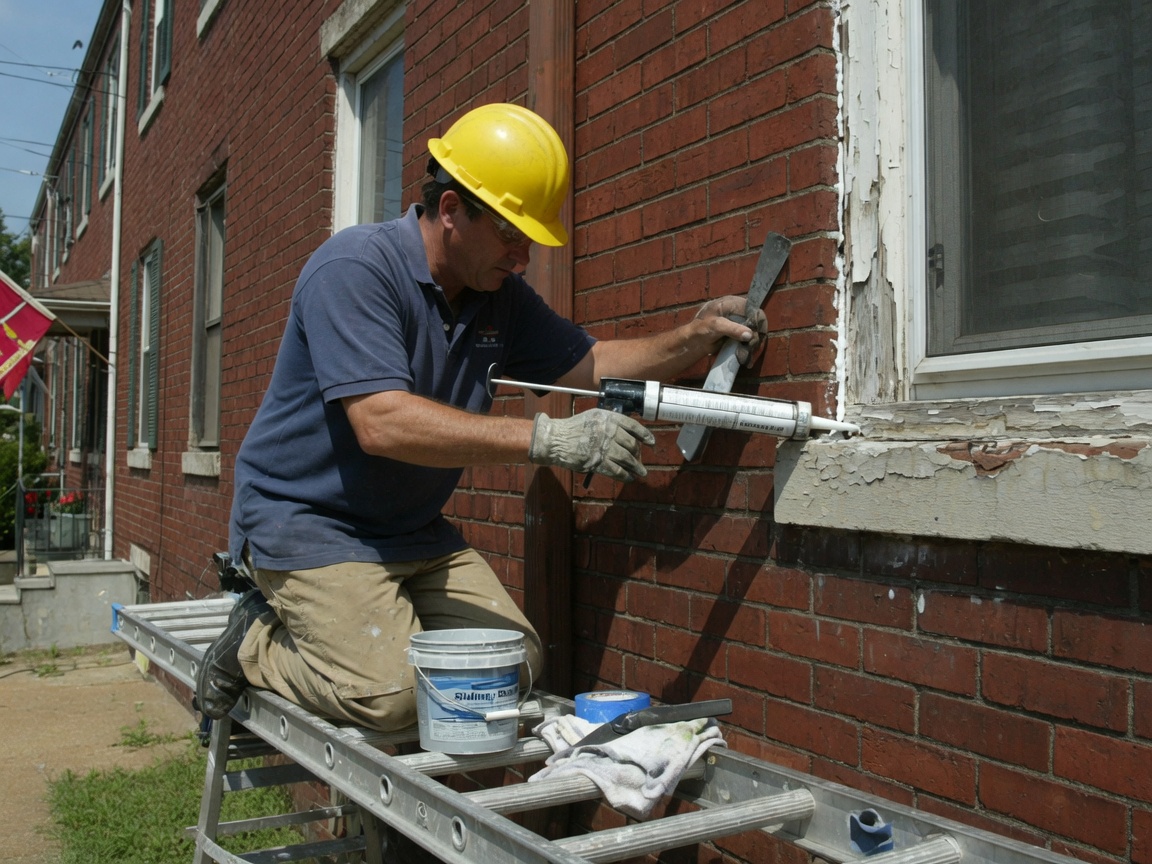
St. Louis homes built before 1950 in neighborhoods like Soulard and The Hill often have wood siding over plaster or early sheathing that moves with seasonal temperature swings. Effective caulking requires backer rod in gaps wider than 1/4 inch and high-movement silicone or hybrid polymer sealants rated for -40°F to 200°F rather than standard latex. Without proper joint width-to-depth ratios, sealant fails within two winters when the independent city’s freeze-thaw cycles pull joints apart.
Severe thunderstorms common from April through October drive water behind trim at window heads and corner boards, especially on south and west exposures. We route water away first by clearing debris from behind fascia and ensuring weep paths remain open before any new bead is applied. In areas near Forest Park or Tower Grove South where mature trees drop leaves into gutters, we also seal the top edge of corner trim to stop water from wicking downward into the siding.
City code requires that any work visible from the street in historic districts such as Lafayette Square or Benton Park preserve original profiles, so we use color-matched sealants and avoid overfill that creates visible ridges. Homeowners in nearby Clayton or Webster Groves with post-war aluminum siding need different prep because the metal expands more than wood; we leave a 1/8-inch gap and use non-sag sealant to accommodate movement without cracking.
Technician insight
In St. Louis the thing that catches most people out with siding caulking and sealing is the way older plaster-lath walls in Soulard and Benton Park continue to move for weeks after a cold snap; if you seal too early the new bead tears before spring.
Failed Sealant on South Wall in Shaw
Homeowner noticed water stains inside a second-floor bedroom after a July thunderstorm. We found the original latex caulk had pulled away from the wood siding on the south elevation where afternoon sun had baked it. After removing the failed material, installing backer rod, and applying hybrid polymer sealant at the window head and corner boards, the wall stayed dry through the next three storms.
Siding Caulking and Sealing Services We Offer
✓Window Perimeter Sealing
Removes failed caulk around double-hung and casement windows then installs backer rod and hybrid polymer sealant rated for St. Louis temperature swings.
✓Door Frame Caulking
Seals the gap between door jambs and siding on both entry and garage doors to block wind-driven rain common during Midwest storms.
✓Siding Joint Sealing
Applies flexible sealant at horizontal and vertical butt joints on wood and fiber-cement siding to prevent water entry during freeze-thaw cycles.
✓Corner Trim and Fascia Sealing
Cleans and seals the top and side edges of corner boards and fascia where water collects behind gutters in older Central West End and Shaw homes.
✓Expansion Joint Maintenance
Replaces hardened material in control joints on larger homes near the Missouri Botanical Garden where thermal movement is greater.
Siding Caulking and Sealing Cost in St. Louis, MO
| Service | Typical Range | What Affects It |
|---|---|---|
| Window and door perimeter sealing (single-story) | $350–$650 | Price rises with two-story access or historic trim profiles in Lafayette Square. |
| Full house joint sealing | $900–$1,800 | Depends on linear footage and whether scaffolding is needed near tall homes in the Central West End. |
| Corner trim and fascia sealing only | $275–$475 | Common add-on when gutters are clogged after spring storms. |
Ranges are typical for St. Louis, MO and confirmed with an exact written quote before any work starts.
How it works
- 1
On-Site Assessment
We inspect every joint from the ground and ladder, noting failed sealant, water stains, and gaps caused by St. Louis humidity and winter contraction.
- 2
Surface Preparation
Old caulk and debris are removed, joints are cleaned with isopropyl alcohol, and backer rod is installed where depth exceeds 1/4 inch.
- 3
Sealant Application
Hybrid polymer or high-movement silicone is tooled smooth with a 1/8-inch concave profile to shed water on south-facing walls exposed to summer storms.
- 4
Cure and Final Walk-Through
We return after 24 hours to check cure and touch up any spots missed due to the city’s variable spring weather.
Pricing
Most St. Louis caulking and sealing jobs are quoted after an on-site visit because house age, number of stories, and access vary widely between Soulard brick homes and Midtown frame houses.